Reynolds Serial Numbers

Due to the lack of surviving serial number records for Reynolds band instruments (apart from some partial 1964-79 data preserved in the Allied Band Supply catalog), accurately identifying a manufacturing date for any given serial number is inherently inaccurate.

The serial numbers and estimated dates presented on this page are based on reported owner records as well as the visual observation of details on hundreds of instruments that I've cross-referenced against catalog illustrations and descriptions and historical company information. While an exact date may never be able to be accurately verified for any given serial number, I believe that the general progression of these lists is defensible and represents Reynolds instruments through the company’s history.

Select the appropriate tab above to see details for the serial number you have.

New research has come to my attention around the 1961-64 time period when RMC owned Reynolds. As was known, manufacturing of the Reynolds/RMC Medalist instruments was outsourced, almost certainly at the Blessing plant in Elkhart, Indiana. It now appears likely that the serial numbers on Reynolds/RMC Medalist instruments were part of Blessing or Indiana Band Instrument sequences. As such, I've removed the relevant Medalist notes from the serial number tables below until I can confirm details and present a more accurate timeline.

Please note that Medalist instruments with serial numbers above 200000 are still included in the All Models (1964-1979) sequence documented below.

I've made two changes to the production estimates for the first decade of manufacturing, 1936-1946:

  • First, I've aligned the earliest military serial numbers with known contracts awarded to Reynolds during WWII (1943-). While it's possible that there were earlier contracts, this has resulted in a more conservative estimate of the number of Reynolds horns produced in the earliest years (when production of the Ohio Band student horns would been the focus).
  • I've also pushed out the date of the vertical monogram engraving pattern to 1946 (based on a personal note received about the timing of the redesigned logo). It's now likely that the engraving pattern change coincided with Foster Reynolds leaving the company in spring 1946 and Scherl & Roth taking over operations.

Finally, a Contempora trumpet has been documented with SN 179xx (1949), making it the new "earliest known" Contempora instrument. There's been a slight ripple in the years immediately before/after to align the production dates.

FAQs

Reynolds serial numbers are typically found in the following locations:

Piston valve instruments (trumpets, cornets, baritones, tuba, etc.)

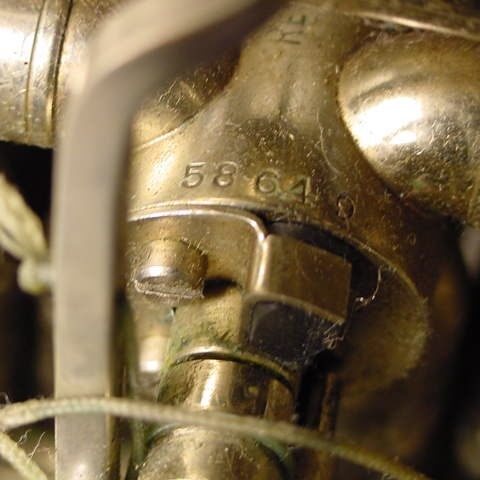
The serial number is stamped on the 2nd-valve casing. Earlier instruments (pre-1965) are stamped horizontally; later instruments may be stamped vertically along the valve length.

Trombones

The serial number is located on both the slide handpiece and the bell section, both near where the two pieces join together.

French horns (and other rotary valve instruments)

The serial number is located on the 2nd-valve casing, typically near the valve arm assembly.

In 1970, manufacturing was consolidated at F.E. Olds in Fullerton, Calif. after CMI sold the Abilene (Texas) plant to Conn. The F.E. Olds and F.A. Reynolds lines began to merge and instruments for both came off the same production lines. There are many examples of these later Reynolds instruments with F.E. Olds serial numbers, e.g. higher than 600000. There are number of Olds serial number charts available; see this one for example.

Still have a question?

Please use the Contact form for any questions not answered here.

The purpose of this website is to preserve the history of the F. A. Reynolds Company and the distinctive qualities of its brass instruments. Contempora Corner and contemporacorner.com are not related or associated in any way to the former or current F.A. Reynolds Company.

Copyright © 2004-2025 ElShaddai Edwards. All Rights Reserved. Terms of Use.